Thursday, October 29, 2020

What if carbon Removal became the new Big Oil?

If carbon removal became the new Big Oil What if carbon removal becomes the new Big Oil? One giant industry emerges as another declines. An imagined scenario from 2050 The World If Jul 4th 2020 edition Jul 4th 2020 Editor’s note: Each of these climate-change articles is fiction, but grounded in historical fact and real science. The year, concentration of carbon dioxide and average temperature rise (above pre-industrial average) are shown for each one. The scenarios do not present a unified narrative but are set in different worlds, with a range of climate sensitivities, on different emissions pathways It is hard to envisage now, but the Permian basin in Texas and New Mexico used to be America’s biggest source of crude oil. At its peak it accounted for more than half of national production. Today the steel pumpjacks have been replaced by direct-air capture (dac) units. Powered by the sun, the machines suck carbon dioxide from the atmosphere and pump it into the sedimentary rock formations below. There is an elegant symmetry in the way the carbon is being pumped back into the ground. Big Oil has given way to Big Suck. The transformation of the Permian region illustrates an industrial shift that began in the early 2020s. The once-mighty oil industry, in its old form, has withered. From its husk a thriving new industry has emerged. Carbon-removal firms now number among the world’s biggest. Alongside big cuts in emissions, their technology has helped stabilise the climate and reduce emissions to net-zero. The atmospheric concentration of carbon dioxide is even beginning to drop as carbon-removal efforts are expanded. At the same time, the industry has reshaped geopolitics—and is creating its own set of environmental impacts. The trouble for Big Oil started in 2014, when booming American production helped spur a plunge in prices. The covid-19 pandemic of 2020 triggered a short, sharp contraction in demand. Longer-term decline was unavoidable. Internal combustion engines in road vehicles, which made up more than two-fifths of oil use in 2020, were starting to give way to electric motors. Further pressure came from the rise in carbon taxes, as governments, cash-strapped after covid-19 bail-outs, sought new streams of revenue. The oil-price spike of the late 2020s simply reinforced the trend towards other forms of energy. Firms that built the kit used in oil production, such as refineries and pipelines, were the first to go bust as investments in new assets ground to a halt. Next up were companies that struggled to divest themselves of pricey oilfields. As oil-producing firms fought for survival, one strategy was consolidation through mergers. In the end, some supermajors ran down their reserves, halted oil investment and were run for cash. By contrast, national oil companies with low production costs, such as Saudi Aramco, kept pumping. But the most innovative giants, sensing an existential threat, realised that if they were to continue supplying oil and gas, they would need to capture and store the carbon emissions they produced, too. By the late 2020s, two methods had emerged as the most effective ways to do this. One was dac, which involves trapping carbon dioxide from the atmosphere by sucking air through an absorbent material. The other was “bioenergy with carbon capture and storage” (beccs), where the absorption is done by trees and crops as they grow. That biomass is then burned for energy and the resulting carbon dioxide is captured. Either way, it is stored underground, permanently removing it from the atmosphere. Before it was brought into being, carbon-capture technology was assumed to be very expensive—one early study of dac suggested costs of $600 a tonne or more. When entrepreneurial start-ups tried it out in the early 2020s, though, it came in at about a third of that. The costs of beccs were never as high, because capturing carbon dioxide from a power-station chimney, where the concentration is about 10%, is inherently more efficient that capturing it from ambient air, where the concentration is just 0.045%. That said, cost estimates for beccs were—and to some extent remain—vexed by the question of how to account for the opportunity cost of the vast plantations it requires. Oil companies already had expertise in putting fluids back underground as well as taking them out: it is how fracking is done. They also had experience in mounting operations on truly large scales—which, when applied to carbon-capture, brought costs down yet further. Increasing the size of an industry by a factor of 50, as happened in the 2020s, gets you a lot of learning by doing. Most important, carbon removal allowed them to continue pumping oil. Their new business model was selling fuels in markets in which there was no feasible alternative, such as long-haul air travel, at “net-zero” prices which included the certified capture of an amount of carbon equivalent to that given off by the fuel’s combustion. It was called “carbon leasing”: the oil company lent the customer fresh new carbon and took old, used carbon back in return. International politics helped. At the cop27 climate conference, in 2022, world leaders finally managed to agree on the creation of an international carbon market in which carbon-removal credits could be traded. This let companies sell removal capacity they did not need for carbon-leasing deals and buy spare capacity when their removal systems let them down. At the same time, the Organisation for Carbon Accounting (oca), a global monitoring body, was spun out of the Intergovernmental Panel on Climate Change. Its real-time audits of carbon-removal facilities gave the industry credibility. The astonishingly rapid scale-up in production—outpacing the construction of railways or power grids in previous eras—was due in part to smart industrial design. Equipment for dac was tailored to existing industrial know-how: that used in car plants, gas-turbine factories, and mining and water-treatment. The beccs industry, for its part, got a boost from genetic modification, in the form of new strains of trees and crops that absorb more carbon dioxide as they grow. The giant carbon-removal utilities which emerged now pull around ten gigatonnes of carbon dioxide out of the skies each year; along with their carbon-leasing businesses and the electricity generated by their beccs plants, that gives carbon-removal companies a collective turnover of more than $1trn. Back into the ground The emergence of this new industry has had far-reaching ramifications, as some locations are better suited to carbon removal than others. Three conditions are needed: storage, space and low-cost power. Storage was the easiest to crack. Many countries have locations suitable for burying carbon dioxide, such as sedimentary or basaltic rock formations. For dac a more important factor was the continuous availability of cheap energy. In some cases this meant building dac plants by geothermal power stations, such as in Iceland. But most large-scale dac facilities depend on solar power, the cheapest energy source. dac plants also need a lot of space. An early estimate, made in 2019 by Howard J. Herzog of the Massachusetts Institute of Technology, was that removing 1m tonnes of carbon dioxide a year from the air would require a facility ten metres high, 3-5 metres wide and 5km long. The technology has become more compact since then, but it is still land-hungry. So today most dac plants are in deserts, where sun and space are plentiful. North Africa is one hotspot, along with Australia and America’s southern states. Space is needed to grow fuel for beccs too, as are weather conditions ripe for growing biomass. Countries in the tropics, notably Indonesia and Tanzania, emerged as big beccs hubs. All this has tilted the scales of geopolitics. Some oil-rich countries, such as Venezuela, have suffered, as oil that is costly and dirty to extract remains below ground. China established a national giant, Sinodac, and solidified its role as the world’s manufacturing hub for batteries and solar panels. Other countries, such as Brazil, Indonesia and Tanzania, gained political clout as their carbon-removal sectors boomed. Money from thin air Carbon removal affected the corporate world, too. Even though the planet has now achieved net-zero emissions, individual companies still emit carbon dioxide and buy carbon credits, in the form of negative emissions, from carbon-removal firms. Unexpected price increases can hit profits in the still-carbonised sectors. That was the case in 2047 when a forest fire near a beccs plant in Kalimantan, Indonesia’s slice of Borneo, destroyed a huge number of trees, which act like temporary storage units for carbon dioxide until it is captured at a beccs plant. The resulting release of carbon dioxide made a big dent in the world’s carbonremoval capacity. Prices shot up and some companies were badly stung (at least those that had failed to hedge in the removals futures market). DeltaAmericanBlueCircle went bankrupt. The removal industry also finds itself under close scrutiny from environmental groups. One concern is just how securely carbon dioxide is stored underground. The role of the industry in the Memphis earthquake of 2042 remains hotly contested. Carbonremoval bosses dismiss these criticisms as nitpicking. Now that the climate has stabilised, they grumble, some environmental ngos are overstaffed, overfunded and have little else to do. A larger headache for bosses is navigating the long-term future of their industry. Large-scale carbon removal will be needed for a few decades yet, after world leaders pledged at cop50 in 2045 to bring atmospheric carbon-dioxide levels down further. But no agreement has been made as to how far. If and when governments agree they are happy for the concentration of carbon-dioxide to remain stable, the growth of the carbonremovals industry will stall and may go into reverse. One route for expansion is cannibalisation. Rivalry between the beccs and dac camps is growing. Both are spending more on marketing and lobbyists. They want to persuade consumers and politicians that their technology is superior, and that humanity’s aim should be to return the atmosphere to pre-industrial levels of carbon dioxide. Despite these efforts, analysts expect the sector to shrink and consolidate in the coming years. That may favour the largest carbon-removal outfits, several of which are also oil producers. The very firms that prospered by taking carbon out of the ground may profit the most from putting it back. ■

Wednesday, October 28, 2020

By reimagining our relationship with time...

(Image credit: Maria Medem) By Roman Krznaric 28th October 2020 By reimagining our relationship with time – and coming to terms with death – we can improve our existence, argues Roman Krznaric. Article continues below ADVERTISEMENT “The word death is not pronounced in New York, in Paris, in London, because it burns the lips,” wrote the Mexican essayist and poet Octavio Paz in the 1950s. But for his fellow countryman – who talks about it and celebrates it in the annual Day of the Dead festival – “it is one of his favourite toys and his most steadfast love”. More like this: - What it really means to ‘seize the day’ - The book that changed Japan’s image - Why embracing change is the key to a good life This was probably an exaggeration, even back then, but it raises the question of the role that death plays in the art of living. Western culture has developed multiple mechanisms for shielding us from the reality of our mortality. The advertising industry tells us that we will remain forever young, we avoid speaking about death with our children, and we shunt the elderly away in care homes out of sight and out of mind. Frida Kahlo painted her 1943 self-portrait Thinking About Death while she was bedridden with ill health; it has been interpreted as viewing death as a path to another form of life Frida Kahlo painted her 1943 self-portrait Thinking About Death while she was bedridden with ill health; it has been interpreted as viewing death as a path to another form of life We must learn to confront the terror of death and develop the courage to explore how awareness of our mortality can help us navigate the now. Just think of Frida Kahlo’s self-portrait Thinking About Death, which has a macabre skull plastered on her forehead. Or consider the pithy wisdom of Albert Camus: “Come to terms with death. Thereafter anything is possible.” But coming to terms with death is easier said than done. One of the secrets for doing so is not to spend hours contemplating visions of the Grim Reaper, but to reimagine our relationship with time itself. Here are three ideas for doing so that offer the unexpected prospect of existential sustenance. In The Death of Ivan Ilyich, a judge on his deathbed finds comfort in a servant, the only person around him who does not fear death (Credit: Alamy) In The Death of Ivan Ilyich, a judge on his deathbed finds comfort in a servant, the only person around him who does not fear death (Credit: Alamy) The dinner party of the afterlife In Leo Tolstoy’s 1886 novella, The Death of Ivan Ilyich, a St Petersburg judicial prosecutor who has dedicated his career to rising through the legal ranks and helping his family achieve a respectable place in bourgeois society lies on his deathbed, aged just 45, wondering if he has wasted his life on superficial pursuits. “What if my whole life has really been wrong?” he reflects bitterly. If we project ourselves to the end of our life, how would we feel about it looking back? The story offers a useful thought experiment. If we project ourselves to the end of our life, when we are lying on our own deathbed, how would we feel about it looking back? Would we feel proud of our achievements? Would we feel that we had sucked the marrow from life? Or might we, like Ivan Ilyich, be filled with regret? The point, of course, is that such reflections can alter how we choose to act in the here and now. My favourite approach to making this temporal journey to the end of our lives is a visioning exercise I call ‘The dinner party of the afterlife’. Imagine yourself at a dinner party in the afterlife. Also present are all the other ‘yous’ who you could have been if you had made different choices. The you who studied harder for exams. The you who walked out on your first job and followed your dream. The you who became an alcoholic, and another you who nearly died in a car accident. The you who put more time into making your marriage work. You then look around at these alternative selves. Some of them are impressive, while others seem smug and annoying. A few make you feel inadequate and lazy. So which of them are you curious to meet and talk to? Which would you rather avoid? Which do you envy? Out of these many yous, is there one who you would rather be – or become? With patterns revealing family history, moko face tattoos are a Māori visual language that forms a connection with ancestors (Credit: Alamy) With patterns revealing family history, moko face tattoos are a Māori visual language that forms a connection with ancestors (Credit: Alamy) The great chain of life A second way to make sense of our existence is to draw on the wisdom of indigenous cultures whose worldviews dissolve the barriers between life and death, offering a sense of transcendence. There is an inspiring Māori concept known as whakapapa, which is their word for ‘lineage’ or ‘genealogy’. It is the idea that we are all connected in a great chain of life that links the present back to the generations of the past and forward to all the generations going on into the future. It allows us to recognise that the living, the dead and the unborn are all here in the room with us. And we need to respect their interests as much as our own It so happens that the light is shining on this moment, here and now, and the idea of whakapapa helps us shine the light more broadly, so we can see everyone throughout the landscape of time. It allows us to recognise that the living, the dead and the unborn are all here in the room with us. And we need to respect their interests as much as our own. Making this imaginative leap is challenging, especially for those of us immersed in a highly individualistic Western consumer culture. But we can begin to do so with help from another thought experiment that involves journeying through time. Think of a child you know and care about – perhaps a godchild, a niece, or one of your own children or grandchildren. Now imagine them at their 90th birthday party, surrounded by family and friends. Picture their aged face, look at what is happening in the world outside the window. And now imagine someone comes over and places a tiny baby into their arms: it’s their first great-grandchild. They look into the baby’s eyes and ask themselves, “What would this child need to survive and thrive into the years and decades ahead?” Sit with that thought for a moment. Then recognise that this tiny baby could be alive well into the 22nd Century. Their future isn’t science fiction. It’s an intimate family fact, just a couple of steps away from your own life. If we care about that baby’s life, we need to care about all life: all the people it will need for support; the air it will breathe; the whole web of life. This kind of thought experiment can help us transcend the limits of our own lifespan and get in touch with the wisdom of whakapapa. We are all part of the great chain of life. And by recognising our place in it, we start extending our sense of what constitutes ‘the now’, shifting from a now of seconds and minutes and hours to a longer now of decades, centuries and even millennia. A now that gives us a sense of responsibility for the legacies we leave for the generations of tomorrow, while respecting the generations of the past. The 2006 Studio Ghibli animation Tales from Earthsea was directed by Gorō Miyazaki, and based on Ursula Le Guin’s Earthsea series (Credit: Alamy) The 2006 Studio Ghibli animation Tales from Earthsea was directed by Gorō Miyazaki, and based on Ursula Le Guin’s Earthsea series (Credit: Alamy) Journeys into deep time We can also rethink our relationship with death by taking the perspective of ‘deep time,’ recognising that humankind, and our own lives, are just an eyeblink in the cosmic story. As the writer John McPhee put it, “Consider the Earth’s history as the old measure of the English yard, the distance from the king’s nose to the tip of his outstretched hand. One strike of a nail file on his middle finger erases human history.” But remember, too, that just as there is deep time behind us, there is also deep time ahead. Any creatures that might still exist in five billion years when our sun dies will be as different from us as we are from the first single-celled bacteria. Deep time enables us to grasp our destructive potential: in just two centuries of industrial civilisation, with our ecological blindness and deadly technologies, we have endangered a world that took billions of years to evolve. Don’t we have a responsibility to preserve the life-giving potential of the Earth for the generations to come? At the same time, situating ourselves in the grand expanse of time helps put our mortality in perspective. We are just a passing moment in a far bigger, longer narrative. We can get there with the help of visionary science fiction writers like NK Jemisin or Ursula Le Guin, who enable our minds to travel across the aeons While deep time is elusive, its wonders are within our grasp. We can get there with the help of visionary science fiction writers like NK Jemisin or Ursula Le Guin, who enable our minds to travel across the aeons. Or try hunting for fossils, and holding a 200-million-year-old ammonite in your hand. Or gaze at stars whose light left their source before humans even evolved. Or make a pilgrimage to an ancient tree and, as novelist Richard Powers expressed it so beautifully, experience life “at the speed of wood”. As we busily swipe our phones and click the ‘Buy Now’ button, let us pause a moment and open our imaginations to a longer now. That is how we begin the journey beyond death. That is how we become good ancestors.

An AI EcoDesign Pandemic Paradise

An AI EcoDesign Pandemic Paradise: Distributed Proximities, Posturban Landscapes and Reconstructed Ruins. Peter R. Diprose and Robert D. Hotten Acadia 2020 Conference: Distributed Proximities “When the wattle-blooms are drooping in the sombre she-oak glade, And the breathless land is lying in a swoon, He leaves his work a moment, leaning lightly on his spade, And he hears the bell-bird chime the Austral noon. The parakeets are silent in the gum-tree by the creek; The ferny grove is sunshine-steeped and still; But the dew will gem the myrtle in the twilight ere he seek His little lonely cabin on the hill.” Service, R W. The Younger Son. 1. The Current Situation: A Pandemic Paradise. New Zealand is currently in an unusual situation when compared with the rest of the world. Due to to its geographical remoteness, being surrounded on all sides by thousands of miles of ocean, New Zealand has very few cases of coronavirus. Body, G. NZ Herald, 16 May 2020 2. The Problem: Ecological Destruction, Isolation and Alienation A: Isolation Aside from the very real economic hardships that will be endured by many, we identify physical distancing (during and after lockdown) as a serious problem to be dealt with. The individual isolation, the fear and rising paranoia associated with the pandemic, and uncertainties over the future are some of the evolving issues. Isolation within small urban housing/apartments distances individuals/families from natural environments, removes spontaneity of shared landscape experience, and the spectacle of theatrical urban space. Diprose & Hotten, An AI EcoDesign Pandemic Paradise, Acadia 2020 1 The need for authenticity of experience and a desire for travel has been denied and continues to be denied in the form of international travel given border closures and fear of the virus. We have shut ourselves off from the rest of the world. B: Ecological Destruction & C: Alienation Isolation combined with the separation from vocation and friends has provided time for introspection and a reassessment of values with its associated social disruption. Problems that have been previously dismissed have been aired post-covid. Examples of this include the environmental debate that has been brought sharply into contrast with months of a low/no movement economy providing clear skies over previously polluted cities. Secondly, entrenched inequalities have come to the fore, highlighting persistent marginalisation and alienation of many. Diprose & Hotten, An AI EcoDesign Pandemic Paradise, Acadia 2020 2 3. Manifesto of Digital Solutions: Posturban Landscapes, Contested Hybrid Landscapes, Distributed Proximities, AI Eco Design and Reconstructed Ruins. For oft when on my couch I lie In vacant or in pensive mood, They flash upon that inward eye ...And then my heart with pleasure fills, And dances with the daffodils. Wordsworth, W. 1807 In our view potentially useful post-covid19 digital solutions that warrant further research include the following: • 1. Posturban Landscapes: Virtual and hybrid digital landscapes: To counter isolation and fear, providing spectacle, novelty or stillness. (Problem A) • 2. Distributed Proximities: To counter commercial and intellectual isolation. (Problem A) • 3. Distributed Proximities: To provide global collaborative initiatives in ecological design through supercomputing. (Problem B) • 4. Distributed Proximities: In the form of artificial intelligence assisted design that blurs mechano-human design agency in environmental design. (Problem B) • 5. GIS/Hybrid landscapes: To counter alienation and inform the observer, revealing political and historical information with contested landscapes. (Problem C) Diprose & Hotten, An AI EcoDesign Pandemic Paradise, Acadia 2020 3 1. Posturban Landscapes: Virtual and hybrid digital landscapes: To counter isolation and fear, providing spectacle, novelty or stillness. (Problem A) Virtual world in terms of the Dominant Social Paradigm pre covid: Vicarious Escapism • Rather than the vicarious escapism offered by negative current mediums (Television, film computer games) • specifically used in an attempt to reclaim lost passion and desire while maintaining a state of ignorance and/conscious avoidance of the ecological problem. Virtual world in terms of a rise New Environmental Paradigm post covid: Intentional Eco-escapism: •Create virtual worlds through which desire can be fulfilled while consciously avoiding actual degradation of the environment or the human spirit •For example - Virtual 3D Architectural follies and/or urban environments, virtual communities. Actual world in terms of the New Environmental Paradigm post covid: Ecological Post Urban space •Designers need to Refocus on the formless aspects of urban design - • Recapture actual community spirit and desire, and those places that reject unbridled consumption. • For example Art Spaces and public gardens - Need for spectacle – novelty satisfied through vicarious landscapes. Irwin Garden at the Getty Center Los Angeles, Diprose & Hotten, An AI EcoDesign Pandemic Paradise, Acadia 2020 4 - Need for stillness and curiosity. - Ryoen-ji, Kyoto - Virtual ruins. Agora of the Italians, Delos Diprose & Hotten, An AI EcoDesign Pandemic Paradise, Acadia 2020 5 - Virtual wilderness The Olgas (Kata Tjuta) “To approach the problem “of the new”, then, one must compete the following four requirements: redefine the traditional concept of the object; reintroduce and radicalise the theory of time; conceive of “movement” as a first principle and not merely a special, dismissible case; and embed these latter three within an all-encompassing theory and politics of the “event”.” Kwinter, S. 2002, Architectures of Time, p11. 2. Distributed Proximities: To counter commercial and intellectual isolation (Problem A) The film and animation studios have shown how distributed proximities can utilised post-covid. An example of this is described in the link below. https://www.cnbc.com/2020/05/23/how-hollywood-movie-making-becomes-virtual-after- coronavirus.html Weta Workshop. Web page -> Design Diprose & Hotten, An AI EcoDesign Pandemic Paradise, Acadia 2020 6 Distributed Proximities: 3 & 4 3. Distributed Proximities: To provide global collaborative initiatives in ecological design through supercomputing. (Problem B) “Entropic and climatic stasis requires humanity to: Reduce carbon uptake, nitrate use, and natural forest destruction... Commission an open input independent global good supercomputing facility; collate, interpret, trend, forecast, update and disseminate all manner of biosphere information and analysis.” Core Adaptation Markers, Page 151 Riddell, Resilience Adaptation Sustainability, Blackwell, 2014. Combined with 4. Distributed Proximities: In the form of artificial intelligence assisted design that blurs mechano-human design agency in environmental design. (Problem B) We propose that we utilise artificial intelligence that could convert architectural norms into appropriately designed forms, and (with some human intervention) simultaneously compare these to mores of cultural landscape, meaning, and theories of art and architecture. A design-morphing machine is proposed within a virtual augmented reality environment as a means of interactively investigating a mosaic of form possibilities. AI Eco Design provides a rich field of opportunities and options that blur current definitions of design agency. It is critical that the design process be assisted by big data and AI to go beyond the ordinariness, and quotidian results such as new urbanism. Analogue example of new design syntheses that could be assisted by an AI Eco Designer. AD HOCISM: AI ECO DESIGN Rural Hillside Town Plan, Auckland, New Zealand, reconstructed ruins from medieval hillside town planning. We suggest that the only way to quickly achieve ad hoc hyper complexity of a reinterpreted medieval town would be through the enhanced agency of AI Eco Design and machine learning design algorithms. Sustainable town, Rennes, France Diprose & Hotten, An AI EcoDesign Pandemic Paradise, Acadia 2020 7 Reference Images and Proposed sustainable village: Rural Auckland 2018 5. GIS/Hybrid landscapes: To counter alienation and inform the observer, revealing political and historical information with contested landscapes. (Problem C) Virtual/Hybrid landscape overlays could inform the visitors to the site, of the hidden and discarded histories associated with those sites. An example of an historical narrative / site is documented in the link below. Image from: NZ Wars: Stories of Waitara, RNZ. https://www.youtube.com/watch?v=fW20zpWlCC8 “This analytical model – based on developmental pathways, dynamical interactions, singular points, and qualitative movements in abstract, sometimes multidimensional space – arguably furnishes a far richer theory of site than most currently employed orthodox aesthetic or architectural practice.” Kwinter, S. 2002, Architectures of Time, MIT Press p28 Conclusion. We identify that the elements of this manifesto would operate simultaneously. A collection of collaborations, as distributed proximities in our pandemic paradise. The whole life ... in which modern conditions of production prevail presents itself as an immense accumulation of spectacles. All that once was directly lived has become mere representation. (Debord, Guy 1995 The Society of the Spectacle Zone Books, p5) Diprose & Hotten, An AI EcoDesign Pandemic Paradise, Acadia 2020 8

How the pandemic might play out in 2021 and beyond

NEWS FEATURE 05 AUGUST 2020 How the pandemic might play out in 2021 and beyond This coronavirus is here for the long haul — here’s what scientists predict for the next months and years. Megan Scudellari Illustration of a line of people walking through a jungle that is filled with Sars-CoV-2 virus. Illustration by Ana Kova PDF version June 2021. The world has been in pandemic mode for a year and a half. The virus continues to spread at a slow burn; intermittent lockdowns are the new normal. An approved vaccine offers six months of protection, but international deal-making has slowed its distribution. An estimated 250 million people have been infected worldwide, and 1.75 million are dead. Scenarios such as this one imagine how the COVID-19 pandemic might play out1. Around the world, epidemiologists are constructing short- and long-term projections as a way to prepare for, and potentially mitigate, the spread and impact of SARS-CoV-2, the virus that causes COVID-19. Although their forecasts and timelines vary, modellers agree on two things: COVID-19 is here to stay, and the future depends on a lot of unknowns, including whether people develop lasting immunity to the virus, whether seasonality affects its spread, and — perhaps most importantly — the choices made by governments and individuals. “A lot of places are unlocking, and a lot of places aren’t. We don’t really yet know what’s going to happen,” says Rosalind Eggo, an infectious-disease modeller at the London School of Hygiene & Tropical Medicine (LSHTM). “The future will very much depend on how much social mixing resumes, and what kind of prevention we do,” says Joseph Wu, a disease modeller at the University of Hong Kong. Recent models and evidence from successful lockdowns suggest that behavioural changes can reduce the spread of COVID-19 if most, but not necessarily all, people comply. Two decades of pandemic war games failed to account for Donald Trump Last week, the number of confirmed COVID-19 infections passed 15 million globally, with around 650,000 deaths. Lockdowns are easing in many countries, leading some people to assume that the pandemic is ending, says Yonatan Grad, an epidemiologist at the Harvard T. H. Chan School of Public Health in Boston, Massachusetts. “But that’s not the case. We’re in for a long haul.” If immunity to the virus lasts less than a year, for example, similar to other human coronaviruses in circulation, there could be annual surges in COVID-19 infections through to 2025 and beyond. Here, Nature explores what the science says about the months and years to come. What happens in the near future? The pandemic is not playing out in the same way from place to place. Countries such as China, New Zealand and Rwanda have reached a low level of cases — after lockdowns of varying lengths — and are easing restrictions while watching for flare-ups. Elsewhere, such as in the United States and Brazil, cases are rising fast after governments lifted lockdowns quickly or never activated them nationwide. The latter group has modellers very worried. In South Africa, which now ranks fifth in the world for total COVID-19 cases, a consortium of modellers estimates2 that the country can expect a peak in August or September, with around one million active cases, and cumulatively as many as 13 million symptomatic cases by early November. In terms of hospital resources, “we’re already breaching capacity in some areas, so I think our best-case scenario is not a good one”, says Juliet Pulliam, director of the South African Centre for Epidemiological Modelling and Analysis at Stellenbosch University. People wearing face masks sitting apart for social distancing at a cinema in Hangzhou, China Cinemagoers in Hangzhou, China, follow new norms of distancing and mask-wearing.Credit: AFP/Getty But there is hopeful news as lockdowns ease. Early evidence suggests that personal behavioural changes, such as hand-washing and wearing masks, are persisting beyond strict lockdown, helping to stem the tide of infections. In a June report3, a team at the MRC Centre for Global Infectious Disease Analysis at Imperial College London found that among 53 countries beginning to open up, there hasn’t been as large a surge in infections as predicted on the basis of earlier data. “It’s undervalued how much people’s behaviour has changed in terms of masks, hand washing and social distancing. It’s nothing like it used to be,” says Samir Bhatt, an infectious-disease epidemiologist at Imperial College London and a co-author of the study. Researchers in virus hotspots have been studying just how helpful these behaviours are. At Anhembi Morumbi University in São Paulo, Brazil, computational biologist Osmar Pinto Neto and colleagues ran more than 250,000 mathematical models of social-distancing strategies described as constant, intermittent or ‘stepping-down’ — with restrictions reduced in stages — alongside behavioural interventions such as mask-wearing and hand washing. Profile of a killer: the complex biology powering the coronavirus pandemic The team concluded that if 50–65% of people are cautious in public, then stepping down social-distancing measures every 80 days could help to prevent further infection peaks over the next two years4. “We’re going to need to change the culture of how we interact with other people,” says Neto. Overall, it’s good news that even without testing or a vaccine, behaviours can make a significant difference in disease transmission, he adds. Infectious-disease modeller Jorge Velasco-Hernández at the National Autonomous University of Mexico in Juriquilla and colleagues also examined the trade-off between lockdowns and personal protection. They found that if 70% of Mexico’s population committed to personal measures such as hand washing and mask-wearing following voluntary lockdowns that began in late March, then the country’s outbreak would decline after peaking in late May or early June5. However, the government lifted lockdown measures on 1 June and, rather than falling, the high number of weekly COVID-19 deaths plateaued. Velasco-Hernández’s team thinks that two public holidays acted as superspreading events, causing high infection rates right before the government lifted restrictions6. Aerial shot of people gathered inside painted circles on the grass encouraging social distancing in a San Francisco park Social distancing could be required intermittently for years to suppress COVID-19 peaks.Credit: John Edelson/AFP/Getty In regions where COVID-19 seems to be on the decline, researchers say that the best approach is careful surveillance by testing and isolating new cases and tracing their contacts. This is the situation in Hong Kong, for instance. “We are experimenting, making observations and adjusting slowly,” says Wu. He expects that the strategy will prevent a huge resurgence of infections — unless increased air traffic brings a substantial number of imported cases. Pandemic on campus: tell us how your institution is coping But exactly how much contact tracing and isolation is required to contain an outbreak effectively? An analysis7 by the Centre for the Mathematical Modelling of Infectious Diseases COVID-19 Working Group at the LSHTM simulated fresh outbreaks of varying contagiousness, starting from 5, 20 or 40 introduced cases. The team concluded that contact tracing must be rapid and extensive — tracing 80% of contacts within a few days — to control an outbreak. The group is now assessing the effectiveness of digital contact tracing and how long it’s feasible to keep exposed individuals in quarantine, says co-author Eggo. “Finding the balance between what actually is a strategy that people will tolerate, and what strategy will contain an outbreak, is really important.” Tracing 80% of contacts could be near-impossible to achieve in regions still grappling with thousands of new infections a week — and worse, even the highest case counts are likely to be an underestimate. A June preprint1 from a Massachusetts Institute of Technology (MIT) team in Cambridge analysing COVID-19 testing data from 84 countries suggests that global infections were 12 times higher and deaths 50% higher than officially reported (see ‘Predicting cases and deaths’). “There are many more cases out there than the data indicate. As a consequence, there’s higher risk of infection than people may believe there to be,” says John Sterman, co-author of the study and director of the MIT System Dynamics Group. Graphic showing how official figures for COVID-19 infections and deaths have been significantly understated in 86 countries. Source: Data from ref. 1, updated with authors’ estimates until 10 July 2020 For now, mitigation efforts, such as social distancing, need to continue for as long as possible to avert a second major outbreak, says Bhatt. “That is, until the winter months, where things get a bit more dangerous again.” What will happen when it gets cold? It is clear now that summer does not uniformly stop the virus, but warm weather might make it easier to contain in temperate regions. In areas that will get colder in the second half of 2020, experts think there is likely to be an increase in transmission. Many human respiratory viruses — influenza, other human coronaviruses and respiratory syncytial virus (RSV) — follow seasonal oscillations that lead to winter outbreaks, so it is likely that SARS-CoV-2 will follow suit. “I expect SARS-CoV-2 infection rate, and also potentially disease outcome, to be worse in the winter,” says Akiko Iwasaki, an immunobiologist at the Yale School of Medicine in New Haven, Connecticut. Evidence suggests that dry winter air improves the stability and transmission of respiratory viruses8, and respiratory-tract immune defence might be impaired by inhaling dry air, she adds. In addition, in colder weather people are more likely to stay indoors, where virus transmission through droplets is a bigger risk, says Richard Neher, a computational biologist at the University of Basel in Switzerland. Simulations by Neher’s group show that seasonal variation is likely to affect the virus’s spread and might make containment in the Northern Hemisphere this winter more difficult9. In future, SARS-CoV-2 outbreaks could arrive in waves every winter. The risk to adults who have already had COVID-19 could be reduced, as with flu, but it would depend on how rapidly immunity to this coronavirus wears off, says Neher. What’s more, the combination of COVID-19, flu and RSV in autumn and winter could be challenging, says Velasco-Hernández, who is setting up a model of how such viruses might interact. Special report: The simulations driving the world’s response to COVID-19 It remains unknown whether infection with other human coronaviruses can offer any protection against SARS-CoV-2. In a cell-culture experiment involving SARS-CoV-2 and the closely related SARS-CoV, antibodies from one coronavirus could bind to the other coronavirus, but did not disable or neutralize it10. To end the pandemic, the virus must either be eliminated worldwide — which most scientists agree is near-impossible because of how widespread it has become — or people must build up sufficient immunity through infections or a vaccine. It is estimated that 55–80% of a population must be immune for this to happen, depending on the country11. Unfortunately, early surveys suggest there is a long way to go. Estimates from antibody testing — which reveals whether someone has been exposed to the virus and made antibodies against it — indicate that only a small proportion of people have been infected, and disease modelling backs this up. A study of 11 European countries calculated an infection rate of 3–4% up to 4 May12, inferred from data on the ratio of infections to deaths, and how many deaths there had been. In the United States, where there have been more than 150,000 COVID-19 deaths, a survey of thousands of serum samples, coordinated by the US Centers for Disease Control and Prevention, found that antibody prevalence ranged from 1% to 6.9%, depending on the location13. What happens in 2021 and beyond? The pandemic’s course next year will depend greatly on the arrival of a vaccine, and on how long the immune system stays protective after vaccination or recovery from infection. Many vaccines provide protection for decades — such as those against measles or polio — whereas others, including whooping cough and influenza, wear off over time. Likewise, some viral infections prompt lasting immunity, others a more transient response. “The total incidence of SARS-CoV-2 through 2025 will depend crucially on this duration of immunity,” wrote Grad, Harvard epidemiologist Marc Lipsitch and colleagues in a May paper14 exploring possible scenarios (see ‘What happens next?’). Graphic showing how immunity and the role of seasons could effect temperate regions in the future. Source: Ref. 14 Researchers know little so far about how long SARS-CoV-2 immunity lasts. One study15 of recovering patients found that neutralizing antibodies persisted for up to 40 days after the start of infection; several other studies suggest that antibody levels dwindle after weeks or months. If COVID-19 follows a similar pattern to SARS, antibodies could persist at a high level for 5 months, with a slow decline over 2–3 years16. Still, antibody production is not the only form of immune protection; memory B and T cells also defend against future encounters with the virus, and little is known so far about their role in SARS-CoV-2 infection. For a clear answer on immunity, researchers will need to follow a large number of people over a long time, says Michael Osterholm, director of the Center for Infectious Disease Research and Policy (CIDRAP) at the University of Minnesota, Minneapolis. “We’re just going to have to wait.” If infections continue to rise rapidly without a vaccine or lasting immunity, “we will see regular, extensive circulation of the virus”, says Grad. In that case, the virus would become endemic, says Pulliam. “That would be really painful.” And it is not unimaginable: malaria, a preventable and treatable disease, kills more than 400,000 people each year. “These worst-case scenarios are happening in many countries with preventable diseases, causing huge losses of life already,” says Bhatt. If the virus induces short-term immunity — similar to two other human coronaviruses, OC43 and HKU1, for which immunity lasts about 40 weeks — then people can become reinfected and there could be annual outbreaks, the Harvard team suggests. A complementary CIDRAP report17, based on trends from eight global influenza pandemics, points to significant COVID-19 activity for at least the next 18–24 months, either in a series of gradually diminishing peaks and valleys, or as a “slow burn” of continuing transmission without a clear wave pattern. Yet these scenarios remain only guesses, because this pandemic has so far not followed the pattern of pandemic flu, says Osterholm. “We’re in a coronavirus pandemic for which we have no precedents.” Mounting evidence suggests coronavirus is airborne — but health advice has not caught up Another possibility is that immunity to SARS-CoV-2 is permanent. In that case, even without a vaccine, it is possible that after a world-sweeping outbreak, the virus could burn itself out and disappear by 2021. However, if immunity is moderate, lasting about two years, then it might seem as if the virus has disappeared, but it could surge back as late as 2024, the Harvard team found. That forecast, however, does not take the development of effective vaccines into account. It’s unlikely that there will never be a vaccine, given the sheer amount of effort and money pouring into the field and the fact that some candidates are already being tested in humans, says Velasco-Hernández. The World Health Organization lists 26 COVID-19 vaccines currently in human trials, with 12 of them in phase II trials and six in phase III. Even a vaccine providing incomplete protection would help by reducing the severity of the disease and preventing hospitalization, says Wu. Still, it will take months to make and distribute a successful vaccine. The world will not be affected equally by COVID-19. Regions with older populations could see disproportionally more cases in later stages of the epidemic, says Eggo; a mathematical model from her team, published in June18 and based on data from six countries, suggests that the susceptibility to infection in children and people under 20 years old is approximately half that of older adults. There is one thing that every country, city and community touched by the pandemic has in common. “There is so much we still don’t know about this virus,” says Pulliam. “Until we have better data, we’re just going to have a lot of uncertainty.”

Monday, July 20, 2020

Oxford University vaccine

Medical researcher with vials

The first results of the Oxford University vaccine trial are expected to be published today.

The vaccine, developed in conjunction with AstraZeneca, is already in large-scale human trials to assess whether it can protect against Covid-19.

However, its developers have yet to report the results of initial phase one testing, which would indicate if it is safe and whether it triggers an immune response. That data is expected to be published in The Lancet medical journal later.

Most experts think a vaccine is likely to become widely available by mid-2021. A vaccine would normally take years, if not decades, to develop - so that would be a huge scientific feat.

But there are no guarantees it will work. Four coronaviruses already circulate in human beings. They cause common cold symptoms and we don't have vaccines for any of them.

Saturday, July 18, 2020

Coronavirus: WHO reports record increase


Coronavirus: WHO reports record single-day global increase in cases

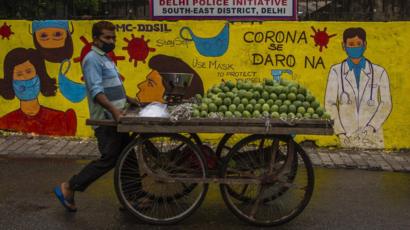
Vendor in New Delhi walks past a mural with doctors and people wearing masksImage copyrightGETTY IMAGES
Image captionIndia currently has the third-highest number of confirmed cases of coronavirus

The number of new cases of coronavirus rose by almost 260,000 in 24 hours - the largest single-day increase since the pandemic began, the World Health Organization (WHO) said on Saturday.

According to the WHO, this is the first time the number of new daily infections has surpassed a quarter of a million.

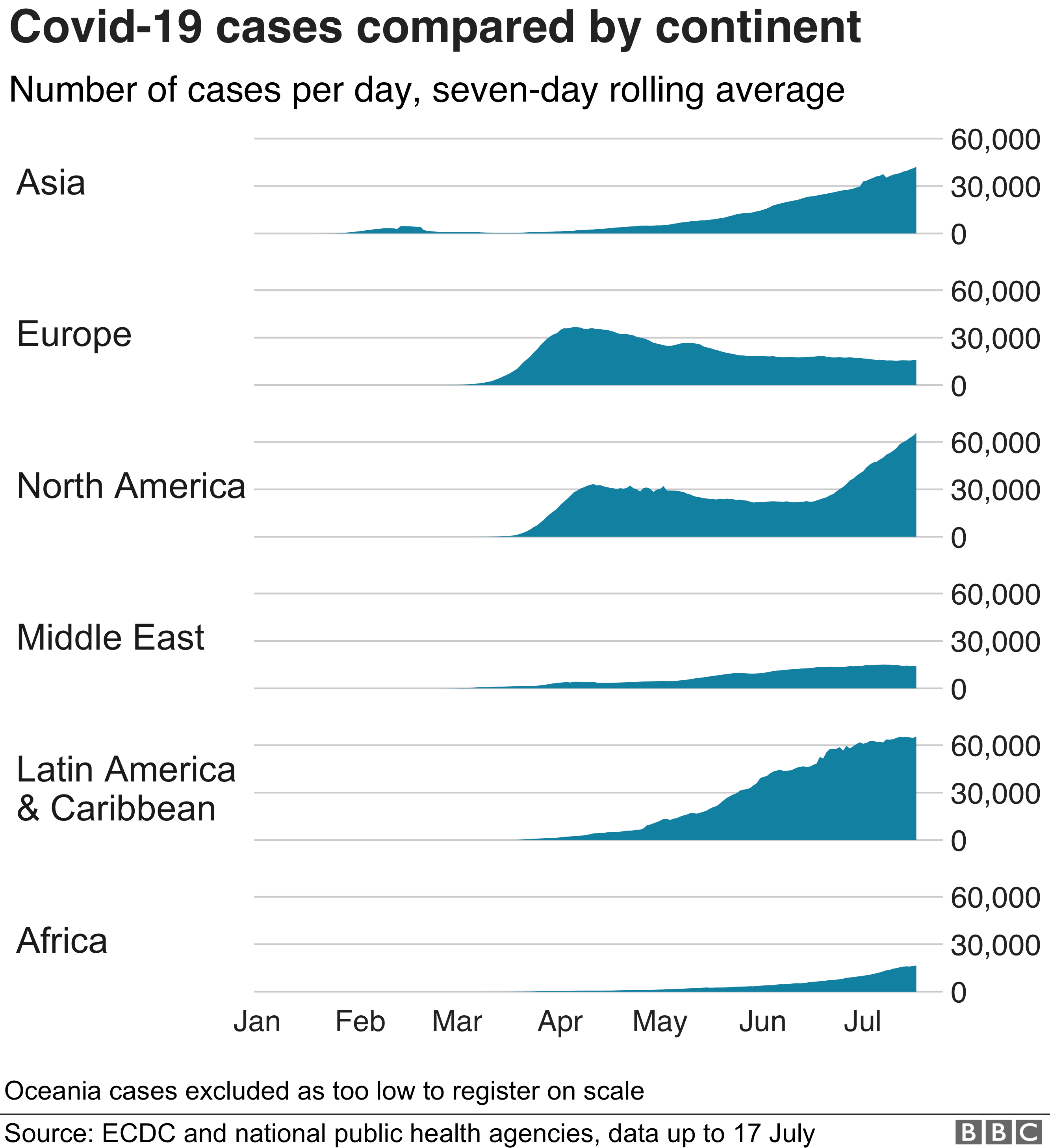
The biggest increases were in the US, Brazil, India and South Africa.

The global death toll from coronavirus also rose by 7,360 - the largest daily increase since 10 May.

The previous record rise in new confirmed cases was recorded by the WHO just one day earlier.

The total number of confirmed cases of coronavirus passed 14 million on Saturday, with over 600,000 recorded deaths, according to the tally kept by US-based Johns Hopkins University. 

What is happening in the US?

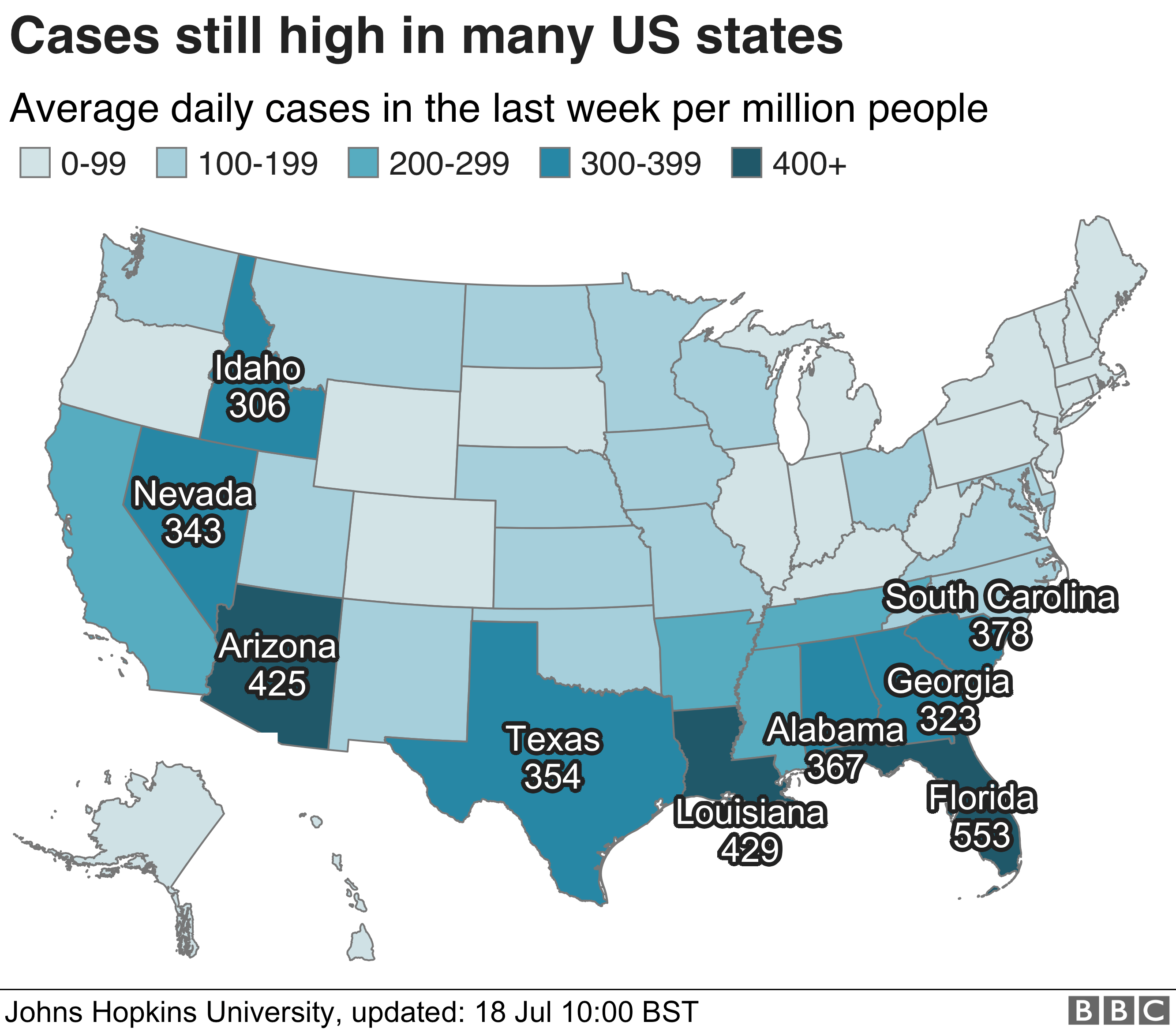
Cases are surging in several US states, particularly in southern states that were initially reluctant to enforce lockdowns or mandate the wearing of masks. Florida, Texas and Arizona have seen particularly high surges.

Florida is currently the epicentre of the US epidemic. The state recorded more than 10,000 new infections and 90 more deaths on Saturday, bringing its total number of cases to more than 337,000 and its death toll to more than 5,000. 

In recent weeks, hospitals across the state had also warned that their ICUs were at capacity and that they were unable to accept any new patients.

Measures to stem the spread of the virus, including wearing masks, have become highly politicised in the US.

Map of rising cases in the US
Chart showing rise in cases by continent
Transparent line

The US's top infectious disease expert Dr Anthony Fauci urged state and local leaders on Friday to be "forceful" in making sure people wore masks, although President Donald Trump later said he would not mandate mask-wearing on a national level.

Which other countries are seeing surges?

In Brazil, where the coronavirus and measures to contain it have been highly politicised, cases continue to surge - although the WHO announced earlier this week that cases were no longer increasing exponentially.

Scientists have also warned that India could still be months away from the peak of its outbreak - despite the country already having the third-highest number of confirmed cases. Hospitals in the worst-hit cities, including Mumbai and Bangalore, have been overwhelmed with patients.

India recorded another 34,884 infections in a 24-hour period on Saturday, and another 671 deaths linked to coronavirus.

And South Africa, which saw one of the largest single-day rises in cases, has the highest number of confirmed infections on the African continent.

What's happening in Europe?

Western European countries, which have managed to largely contain the spread of the virus, are now beginning to reopen their borders and businesses.

However, there are localised surges across Spain - the worst being in the country's north-eastern Catalonia region. 

Banner image reading 'more about coronavirus'
Banner

The region has again recorded a daily increase in confirmed cases of more than 1,000, and about four million people in ​​Barcelona, ​​La Noguera and El Segrià have been ordered to stay at home for 15 days.

Among the measures imposed are a ban on public or private meetings of more than 10 people, a ban on visits to nursing homes, and the closure of gyms and nightclubs.

Spain only ended its tough national lockdown about four weeks ago and was hoping to kick-start the economy, particularly with tourism numbers.

The streets of Barcelona were reported emptier on Saturday, although some residents may have defied orders and headed off in cars for second homes.

Shopkeeper closing up in La Rambla, BarcelonaImage copyrightREUTERS
Image captionCases are surging in Spain's north-eastern region of Catalonia

Neighbouring France is now considering closing borders with Spain in response to the surge.

When asked whether a closure of borders could be possible, new Prime Minister Jean Castex said: "We are monitoring this very closely, here in particular, because it is a real issue that we also need to discuss with the Spanish authorities."

The French border was only reopened to general citizens on 21 June.

How are the EU's plans for coronavirus relief going?

On Saturday, discussions in Brussels over a huge post-coronavirus economic recovery plan ground on.

The second day of talks received mixed reviews. Italian Prime Minister Giuseppe Conte said talks were deadlocked but Austrian Chancellor Sebastian Kurz said he thought they were going in the right direction.

Some "frugal" northern nations like the Netherlands and Sweden have balked at the €750bn ($857bn; £680bn) package, arguing it should be loans not grants.

A revised plan would tone down the level of grants but there appears to be a long way to go.

The talks are now going into a third day on Sunday.